systems / overdub
OVERDUB
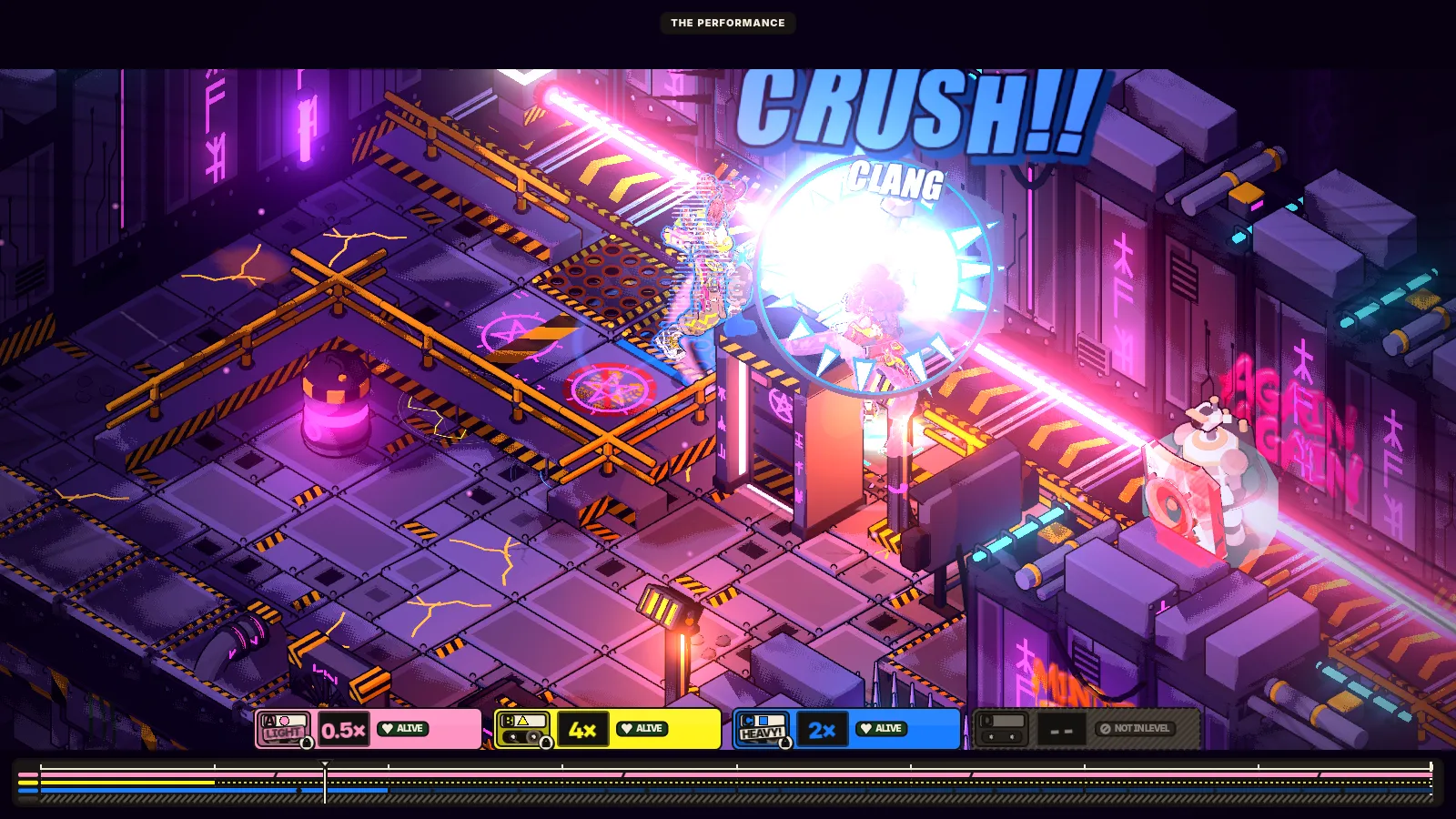
An isometric action-puzzle game where you record four versions of yourself onto cassette
Determinism is a feature you can play.
- Period
- November 2026
- My role
- Creator. Wrote the 92-page requirements and visual bible, then designed and directed the build, the simulation, the music system, and the asset pipeline.
- State
- Twelve-level campaign, playable end to end. Open source.
- 163Golden scenariosreplayed tick for tick against the reference build
- 92 pagesRequirements bibleevery requirement mapped to an acceptance check
- 12Campaign levelsevery one replayed from its stored solution by the test suite
- Godot 4.4
- GDScript
- TypeScript
- Vitest
- Blender
- Python
- gpt-image
- ElevenLabs
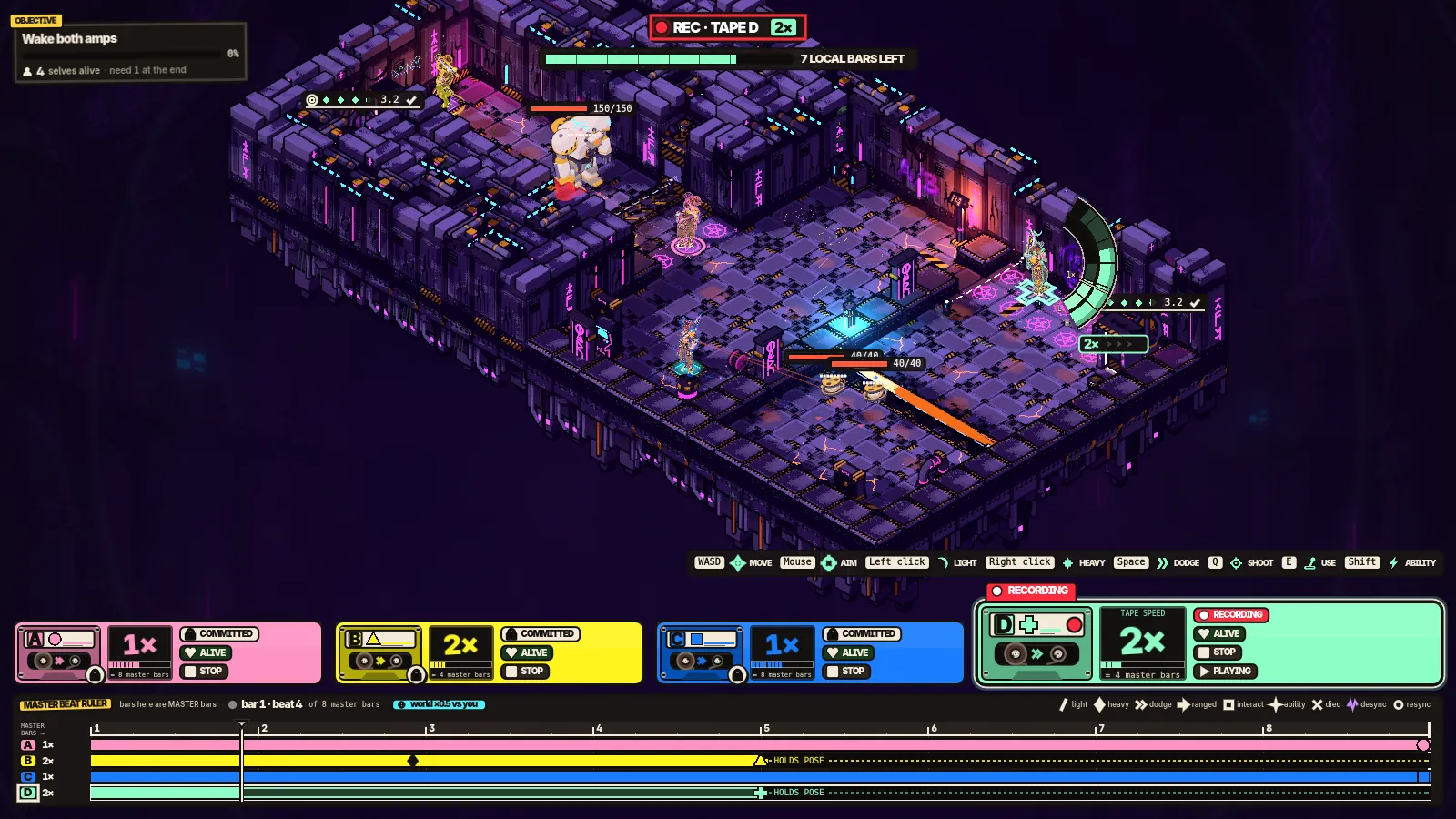
Diagram nodes, in flow order: Requirements bible (92 pages · every row a test); TypeScript prototype (executable rules reference); Golden scenarios (163 byte-identical exports); Deterministic core (no nodes · no clock · no RNG); Session and campaign (four tapes · one timeline); Music director (one layer per cassette); Cinematic director (plans the winning replay); Asset pipeline (Blender scripts · gpt-image · voice).
The idea
Most time-loop games give you one ghost. OVERDUB gives you a four-track tape deck. Each cassette has its own tape speed and its own end mode, so a take recorded at half speed plays back stretched across the level while the next one runs at double time. Puzzles are solved by arranging performances: one Moxie holds a pressure plate, one draws fire, one carries the key, and the fourth walks through the door they opened together.
The music works the same way. Each level's score is four generated layers, one per cassette. A layer sounds only while its tape is recorded, and it reacts when that copy dies, desyncs, or plays in reverse, so you can hear a solution coming together.
How it is built
The rules were written first as a TypeScript prototype, which stays in the repository as the executable reference. The Godot game's simulation is a port that has to agree with it tick for tick: 163 golden scenarios are exported from the prototype and replayed through the Godot simulation on every test run. The core has no nodes, no clock, and no randomness. That is what makes four simultaneous replays, instant retries, and a cinematic replay of the winning run all fall out of the same code.
On top of the core sit a session state machine, combat feel, traps, enemies, a music director with its own synthesiser and quantised effects, and a cinematic director that analyses the winning performance and plans camera shots so the chain of cause and effect stays readable.
Spec to software with AI
I wrote a 92-page requirements and visual bible, then built the game with coding agents in T3 Code. Every requirement ID maps to an acceptance test, and a test fails if the quoted requirement drifts from the spec. Every file in assets/ is produced by a script: Blender 4.5 Python for robots, kit, traps, and weapons; image generation for textures, twenty portraits, key art, and thirty field-guide plates; a cast of synthesised voices. Change the source, rebuild, and the game picks it up. The in-game field guide's 202 factual claims are each traced to a source and rechecked by script.
It is my favorite demonstration of what a sharp spec, a strict test harness, and a team of agents can ship in a matter of days.