systems / rayneo-hud
RayNeo iO HUD
Smart glasses as a heads-up display for my agents, messages, media, and home
The phone is a radio. The glasses are the screen. The agent is the app.
- Period
- November 2026
- My role
- Creator. Designed the screens and control scheme; built the Android companion, the Bluetooth transport, the gateway, and the companion apps; brought it up on custom firmware.
- State
- My daily driver, running on Turbo-IO custom firmware. Open source.
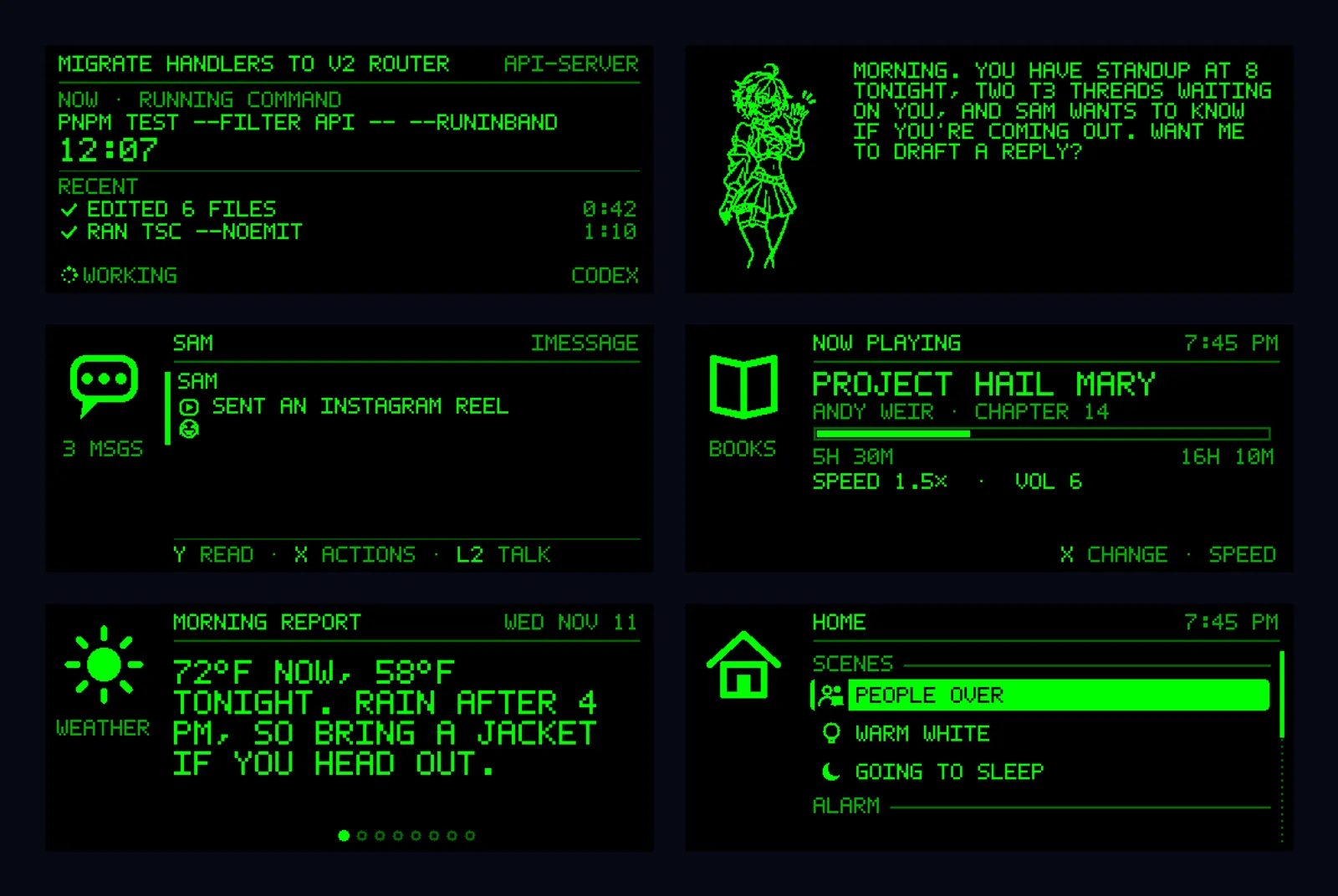
- 16Screensagent, messages, coding threads, media, calendar, health, home, and more
- 9Services behind one gatewayHermes, T3, Beeper, Spotify, Calendar, Oura, Home Assistant, Audiobookshelf, transcription
- 75Screen states with pixel referencesKotlin renderer matches the HTML simulator to within 0.1%
- 50Joy avatar animationsthree frames each, packed to one bit
- Kotlin
- Android
- Bluetooth LE
- RFCOMM
- Protobuf
- Node.js
- Docker
- Cloudflare Tunnel
- Hermes
- Home Assistant
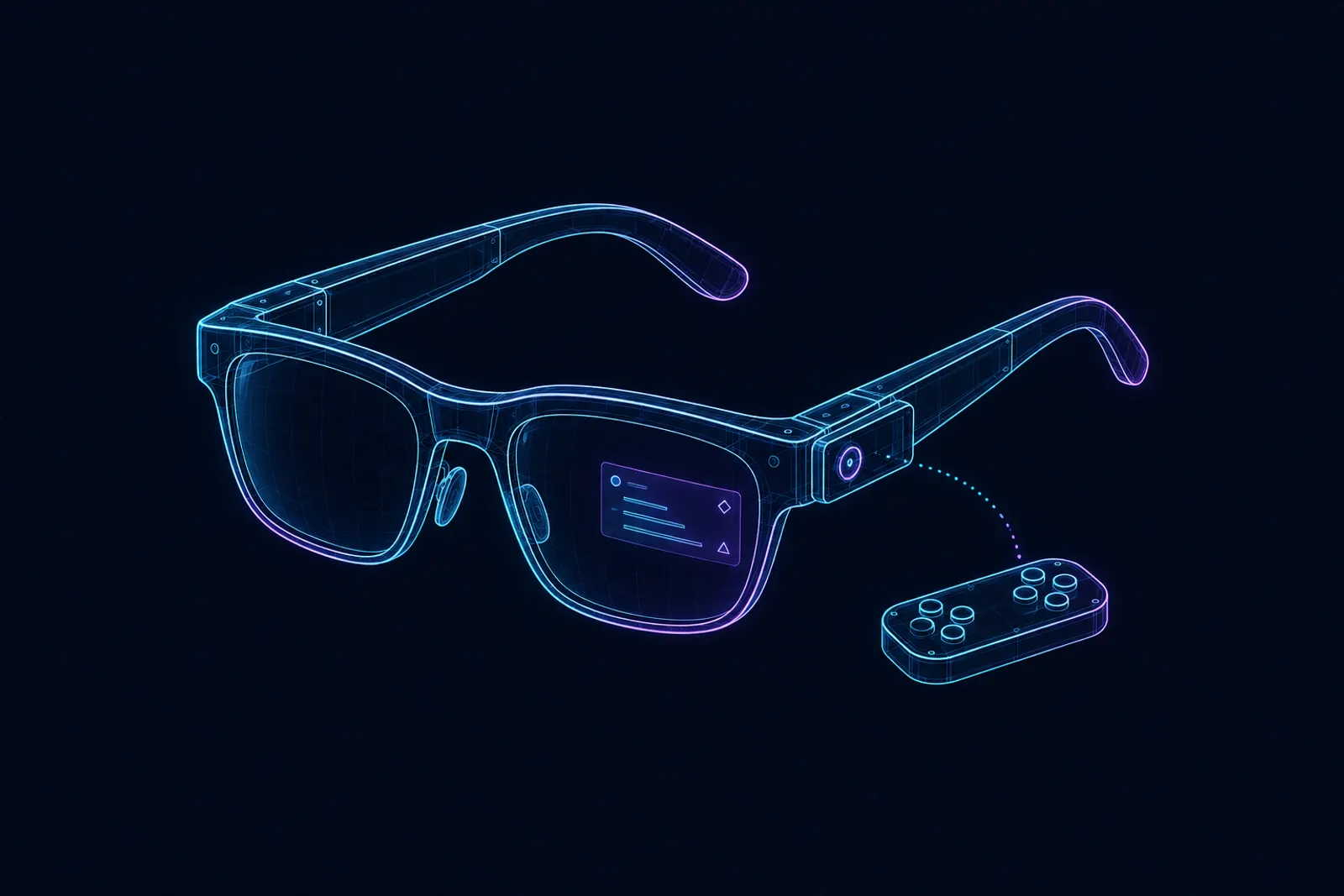
Diagram nodes, in flow order: 8BitDo Micro (pocket controller · push-to-talk); Android companion (input · screens · renderer); Bluetooth transport (BLE login · RFCOMM · protobuf); RayNeo iO (Turbo-IO firmware · 540×220); HTML simulator (pixel-parity reference); joy-api gateway (one container · Cloudflare tunnel); Joy on Hermes (agent · voice · memory); Services (Beeper · T3 · Spotify · HA · Oura).
Why
Most of what I do on a computer comes down to four things: talking to my agent, managing coding-agent threads, answering messages, and playing media. Every one of those already runs through an API I control. So I bought a pair of RayNeo iO glasses and an 8BitDo Micro, and replaced most of my phone with a screen in front of my eye and a controller in my pocket.
How it works
The phone app owns everything: controller input, a screen stack, a renderer, and the transport. Every screen draws twice, once as a 540 by 220 image for custom firmware and once as a 26 by 7 character grid for stock firmware, so the same app drives any pair of glasses.
The transport speaks the glasses' own protocol: a Bluetooth LE login, a classic RFCOMM serial channel, and protobuf messages across twelve channels. I built it in Kotlin on top of the community's protocol research and hardened it against what the hardware actually does in the field, like GATT operations that come back busy and need a retry, and a caption page that accepts a microphone start but never streams. On the Turbo-IO R1 build the assistant recorder streams microphone audio within 300 milliseconds, and full raster screens go out one to one.
Screens are designed first in a single-file HTML simulator. The Kotlin renderer redraws the same 75 screen states, and tests compare the two pixel by pixel. The worst case is under a tenth of a percent.
The gateway
The glasses never talk to a service directly. One Node container, joy-api, sits behind a Cloudflare tunnel on my home server and connects to Hermes, T3 coding agents, Beeper, Spotify, Google Calendar, Oura, Home Assistant, Audiobookshelf, and transcription. A new integration is a module on the gateway and a screen in the simulator.
Companion apps
The same platform carries a bike-navigation app with voice place search and turn-by-turn directions, and a skate companion with ride tracking, Strava export, and board-light control. Each is its own library with its own tests that plugs into the phone app.